

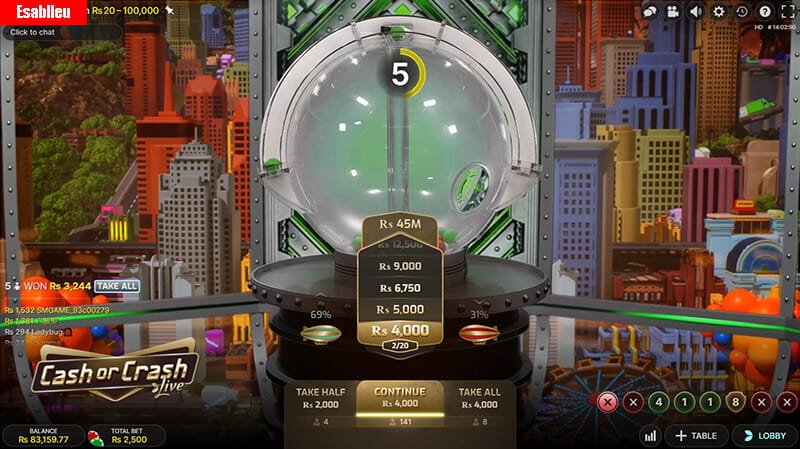
As an detailed reviewer who has devoted considerable time examining live casino games, I find the concept of Return to Player (RTP) in a game like Cash Or Crash Live particularly captivating. For Canadian players, understanding this figure isn’t just about seeing a percentage; it’s about understanding the unique risk-reward mechanics that define every round. This game, with its live host and escalating multipliers, presents a exhilarating deviation from standard slots or table games. My goal here is to break down the RTP, explain how the game’s volatility and mechanics directly influence your potential returns, and offer a unambiguous, practical expectation for your gameplay. Let’s delve into what makes this game’s payout structure operate and how you, as a player, can navigate its thrilling pressures.
Given the game’s volatile nature and choice-driven nature, strategy is less about finding a “winning system” and rather about intelligent bankroll and psychological management. First, consider your buy-in as fun money you are willing losing. Due to the possibility for sudden consecutive crashes, I suggest a bankroll that can survive at least 20-30 rounds at your chosen bet size. This prevents you from being cleaned out by a short-term negative variance before you even have a opportunity to make a significant cash-out decision. Canadian players should also fully utilize of the game’s demo mode if accessible, to sample the tension without monetary risk.
A practical tactic is to set fixed cash-out points before the round starts. For illustration, you might decide you will always cash out at 5x, or use a progressive approach (cash out half at 3x, the rest at 10x). The essential is to follow this plan despite the host’s prompting or the intensity of the moment. Deviating on a whim is where losses can escalate. Furthermore, consider the law of diminishing returns. Going after the hard-to-get 500x or 1000x multiplier is a lottery-like probability. Building a strategy around the more commonly occurring mid-range multipliers (like 5x to 25x) can lead to a more sustainable and rewarding session.
If you use a casino bonus to play Cash or Crash Live, be keenly aware of the wagering requirements. Volatile games can be tricky for clearing playthrough conditions, as your balance can swing dramatically. A large win might help you meet requirements quickly, but a streak of crashes could also exhaust your bonus funds before you complete them. Examine the terms carefully, as some bonuses may limit or count differently to live dealer games. A sensible approach is to use smaller bonus funds or free bets on this game, keeping your main deposit for more consistent gameplay if your goal is to clear a bonus.
Before we concentrate on Cash or Crash Live specifically, it’s essential to determine what RTP means in the live casino landscape. RTP, or Return to Player, is a theoretical percentage reflecting the money wagered on a game that is projected to be paid back to players over an extended period. For illustration, a 96% RTP indicates that for every $100 wagered, $96 is anticipated to be returned as winnings. However, this is a long-term statistical average across millions of rounds, not a promise for a single session. In live games, this determination integrates the built-in rules and odds, as with in a digital game, but is performed in real-time by a human dealer. This provides a layer of confidence for players, as the outcome is determined by physical game elements—like the draw of balls or the crash of a rocket—rather than a digital random number generator alone.
The practical implication for you, a Canadian player, is that RTP functions as a standard for game fairness and potential value. A higher RTP typically indicates a lower house edge over time. It’s a key metric I consistently evaluate, as it permits for a more knowledgeable choice about where to place your bankroll. Nevertheless, with live games offering interactive and bonus elements like Cash or Crash, the RTP story becomes more nuanced. The reported figure is a composite of all possible game outcomes, weighted by their probability. Therefore, your personal experience can fluctuate dramatically in the short term due to volatility, which is why grasping the game’s mechanics is just as critical as recognizing the top-line RTP percentage.
This is the most critical section for your practical understanding. The advertised RTP of ~96.50% presumes a mathematically ideal infinite playstyle that somehow miraculously knows when to cash out before every crash—which is unachievable. In reality, your personal effective RTP is a result of your cash-out strategy. If you consistently cash out at very low multipliers (like 1.5x or 2x), you will win more frequently but your total return may be lower than the mathematical maximum because you’re not capturing enough value from the higher multipliers that the game’s mathematics factors in.
An high-risk player aiming for 10x, 25x, or even 50x multipliers will experience intense volatility. They will experience many more crashes (losses), but a single successful high-multiplier cash-out can recover many losses. Their session RTP could wildly exceed 96.50% or fall far below it. A conservative player withdrawing at 2x or 3x will have more regular smaller wins, leading to a smoother session but perhaps a lower long-term return if they never benefit from the game’s profitable upper tiers. Your decision profile effectively determines the equation for your returns.
From my strategic perspective, a balanced strategy often works best for Canadian players looking to extend playtime and manage risk. This might involve allocating your bet or your session into different approaches. For illustration, you could use a portion of your bankroll to pursue a defensive strategy on one bet, while using another to take infrequent aggressive shots. There’s no scientifically “correct” strategy that beats the house edge, but by being conscious of how your choices alter the payout frequency and size, you can align the game’s experience with your personal risk appetite and financial goals for the session.
To put into perspective the value of Cash or Crash Live’s ~96.50% RTP, it’s useful to contrast it to other live dealer essentials available to Canadian players. Classic Blackjack, based on specific rules and your playing strategy, can provide an RTP often ranging from 99.5% down to around 98%. Live Roulette (European single-zero) provides a 97.3% RTP. Live Baccarat (betting on Banker) is generally around 98.94% RTP. These games have reduced volatility and more expected outcomes based on fixed odds. In contrast, many live game shows like Dream Catcher or Monopoly Live have RTPs in a comparable range to Cash or Crash (often 96%-96.5%) but with varying volatility structures and bonus mechanics.
This comparison indicates that Cash or Crash Live’s RTP is typical for its game-show genre but usually lower than optimal-play table games like Blackjack or Baccarat. The trade-off is the special entertainment value and the player agency it provides. You are not just anticipating for a card or a wheel result; you are actively making a high-stakes decision every few seconds. For many players, this interactive thrill justifies the slightly higher house edge compared to traditional tables. It’s less about pure mathematical maximization and more about captivating entertainment with a solid payout potential.
A widespread belief is that the chance of a crash increases the longer the rocket flies. In actuality, operating under a mathematically fair model, each next step is an separate occurrence (or close to self-contained in its programming). The rocket does in no way have a “memory”; achieving 10x does not inherently make a crash at 11x more likely. The odds are readjusted at each phase depending on the game’s core mechanics intended to deliver the designated RTP. This is crucial to understand, as it avoids the gambler’s fallacy of believing “it’s due to crash” after numerous high multipliers, or on the flip side, that it’s “on a hot streak.”
Another major misunderstanding is mistaking RTP with personal results. As I’ve emphasized, 96.50% RTP is not a promise for your hour-long session. You could win double your money or lose your whole stake. The RTP becomes evident over countless of rounds globally. Additionally, some players mistakenly believe their withdrawal timing can always beat the house edge. While your actions affect your own fluctuations, the game’s basic math ensures the house keeps its edge over the extended period. Your aim should be to enhance enjoyment and manage your risk within that framework, not to find a legendary “beat the game” strategy. Acknowledging these facts will lead to a more mindful and more satisfying gaming activity.
To really grasp the RTP, you should first understand how the game works. Cash or Crash Live is a game show format live dealer experience where you make a bet before a round commences. A live host then propels a virtual rocket through a multiplier field, which contains green safe zones and red crash zones. The rocket goes through a series of increasingly higher multipliers. Before each new multiplier is displayed, you must determine: cash out and secure the current multiplier on your bet, or let it ride for a opportunity at a higher one. The risk is that if the rocket hits a red “Crash” zone before you cash out, you forfeit your bet for that round. This produces a tense, player-driven decision point that is central to the experience.
The complete strategic burden of the game relies on your cash-out timing. There is no optimal moment set by the game; it is a true test of risk tolerance. The live host builds anticipation, and the display of the rocket climbing through multipliers is remarkably engaging. This element means that two players with identical bets can have drastically different outcomes based entirely on their personal decisions. One might cash out early at a 2x multiplier consistently, while another might chase the 10x or 25x multipliers, endangering a total loss more often. Your personal RTP in this game is, thus, partially in your hands, which is a rare and captivating aspect for a live dealer title.
Beyond the core bet, the production value is high. The set is colorful, the host is engaging, and the pacing is crafted to keep adrenaline high. Rounds are fairly quick, allowing for many decisions in a short session. This fast pace impacts how you experience volatility. You’ll face the cash-out dilemma over and over, which can lead to emotional decision-making. As a reviewer, I advise setting a personal strategy for multiplier targets before you start playing and holding to it as strictly as possible, as the live entertainment can entice you to deviate from sensible bankroll management.
Now, let’s get to the exact numbers. Based on my analysis of the game’s rules and published data from respected casinos featuring it in Canada, Cash or Crash Live generally features a Return to Player (RTP) of approximately 96.50%. This is a highly favorable rate, standing above the average for many online slots and similar to favorable table game rules. This figure is calculated by the game provider, Evolution, taking into account all possible crash points and the associated multipliers, and is verified by independent testing agencies. It confirms that, numerically, the game is designed to be fair and provides good long-term value relative to other casino offerings.
That said, the RTP represents only half the story. The volatility of Cash or Crash Live is clearly high. Volatility relates to the frequency and size of payouts. A high-volatility game means wins can be rarer but potentially larger when they occur, leading to substantial swings in your bankroll. In this game, the “crash” events represent total losses, while successful cash-outs at high multipliers deliver substantial wins. This produces a “feast or famine” pattern. You must be economically and emotionally prepared for the possibility of several consecutive losses while hoping for a high-multiplier cash-out to hit. Your session RTP will be very responsive to these swings.